
Paint Sheens in Order & Specular Light Reflectance Guide
Read 45-Word Color Summary & Undertone Verdict
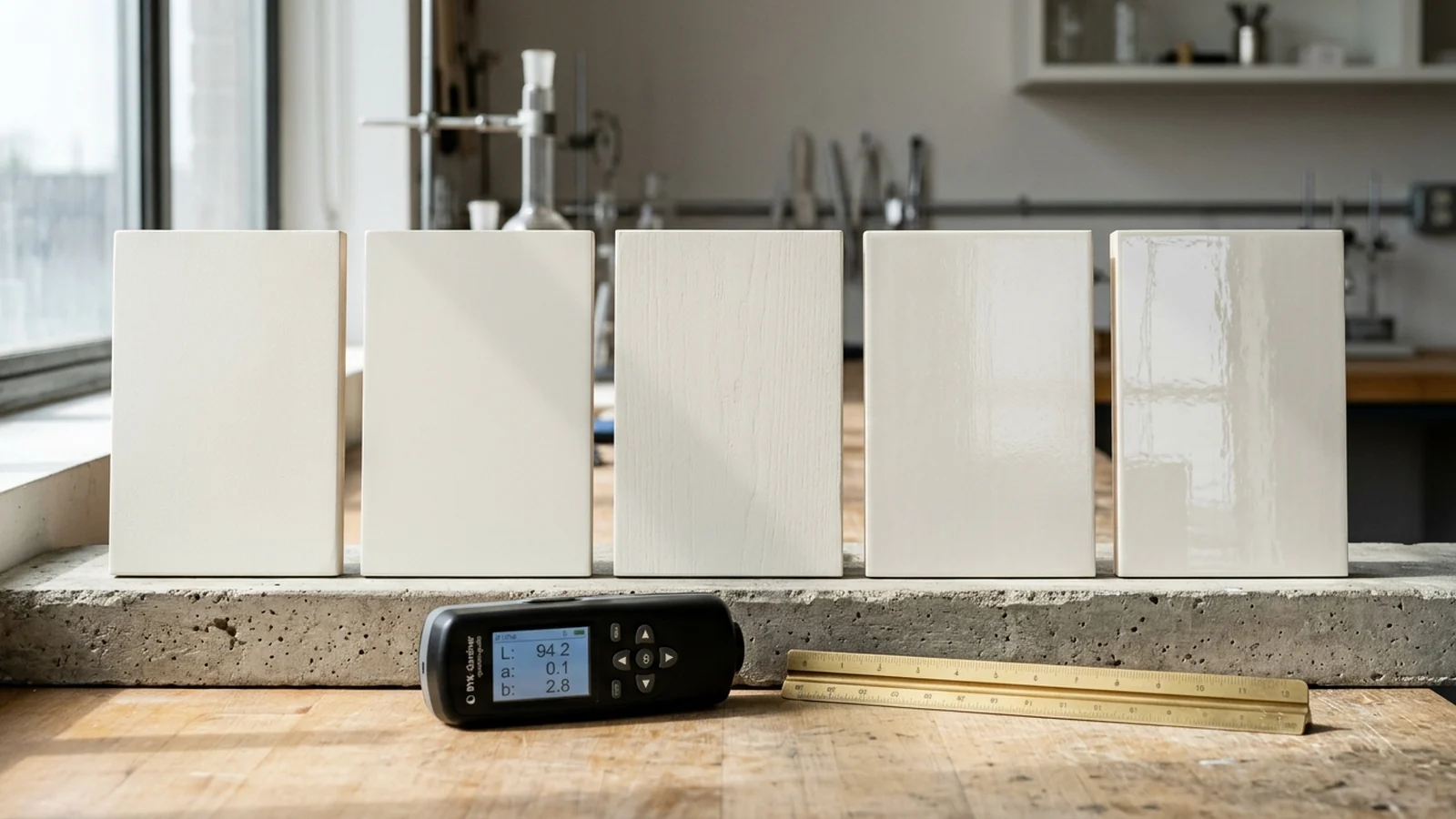
Paint sheens in order from flat to semi-gloss govern specular reflectance and apparent Light Reflectance Value across interior spaces. Selecting the right wall paint sheen—satin vs eggshell, matte vs flat—balances cleanability against microscopic light diffusion under ASTM D523 measurement standards.
Will Alabaster Turn Yellow in Your Room?
Check how Alabaster and coordinating Sherwin-Williams colors shift under your living room bulbs (2700K Warm White vs 5500K Daylight) — calibrated to ASTM E313 reflectance data.
Soft creamy warmth; stays balanced white in 5000K daylight, cozy cream under 2700K lamps.
Soft creamy warmth; stays balanced white in 5000K daylight, cozy cream under 2700K lamps.
Partner disclosure: Test physical peel-and-stick samples on North & South walls before buying gallons. We may earn a small commission at zero extra cost to you.
Read 45-Word Color Summary & Undertone Verdict
Sherwin-Williams Alabaster (SW 7008) is an iconic, warm, creamy off-white with an LRV of 82.0 and a balanced beige undertone that prevents it from looking sterile. In North-facing light, it stays warm without turning stark gray; under 2700K incandescent bulbs, it delivers a cozy, glowing cream finish without muddy yellow cast.
What are paint sheens in order from lowest to highest gloss level?
Paint sheens in order of standardized 60° specular gloss units (GU) progress from non-reflective Flat to high-durability Semi-Gloss and Gloss finishes. If measured using a calibrated specular glossmeter under ASTM D523 criteria, then each progressive sheen level reflects a greater proportion of directional incident light.
Flat / Dead Flat (0–3 GU at 60° / <5 GU at 85°): Completely absorbs directional light, hiding drywall tape joints and ceiling imperfections with velvety uniformity.
Matte (3–7 GU at 60° / 5–10 GU at 85°): Slightly richer binder concentration than flat, allowing gentle wipeability while maintaining a soft, non-reflective appearance.
Eggshell (10–15 GU at 60° / 15–25 GU at 85°): The industry-standard residential wall paint sheen, balancing soft low-luster reflectance with scrubbable resin durability.
Satin (20–30 GU at 60° / 30–45 GU at 85°): Silky medium-luster finish ideal for high-traffic hallways, children’s rooms, mudrooms, and humid bathroom drywall.
Semi-Gloss (35–50 GU at 60°): High-durability enamel designed for doors, baseboards, window casings, kitchen cabinetry, and architectural wainscoting.
How does paint sheen alter the perceived Light Reflectance Value (LRV) of Alabaster?
Light Reflectance Value calculates total hemispherical diffuse reflection, yet specular gloss alters perceived lightness across human observer angles. If Alabaster SW 7008 is painted in semi-gloss, then directional highlight glares can cause surfaces to appear 2 to 4 LRV units lighter than identical paint applied in flat.
Microscopic surface topography in matte paint scatters reflected light in all directions (Lambertian diffusion), preserving the truest, softest reading of Alabaster’s subtle greige pigments.
Higher sheen levels (Satin, Semi-Gloss) create directional specular reflections that mirror window positions and ceiling lamps. In rooms with grazing raking light, high-gloss sheens magnify minor drywall dimples and roller stipple.
Architects specify eggshell for living room walls and semi-gloss for trim to establish tactile surface separation between adjacent architectural planes without changing tint formulas.
Satin vs eggshell: Which wall paint sheen is best for high-traffic living spaces?
The debate between satin vs eggshell centers on scrub resistance versus surface forgiveness across high-traffic living environments. If drywall substrates exhibit minor taping seams or texturing, then eggshell (10–15 GU) provides superior flaw concealment while remaining washable with microfiber cloths.
Satin paint (20–30 GU) contains a higher ratio of acrylic binder to titanium dioxide pigment, resulting in a tighter, less porous cured paint film.
This tighter polymer barrier resists moisture absorption, grease splatter, and crayon marks, making satin the superior option for laundry rooms, active playrooms, and kitchen perimeters.
For formal living rooms, dining rooms, and primary suites with large continuous drywall spans, eggshell remains the preferred designer choice to avoid distracting specular glare under chandelier lighting.
Paint Sheens in Order: 60° Specular Gloss & Durability Specifications
The table below quantifies standardized 60° specular gloss units (GU), 85° sheen angles, and washability ratings across all architectural paint sheen categories under ASTM D523 criteria.
| Sheen Level | 60° Specular Gloss | 85° Sheen | Scrub Resistance | Drywall Imperfection Hiding | Target Application |
|---|---|---|---|---|---|
| Flat / Dead Flat | 0–3 GU | < 5 GU | Low (Touch-up only) | Maximum (99% Diffusion) | Ceilings, low-traffic formal spaces |
| Matte | 3–7 GU | 5–10 GU | Moderate (Gentle wipe) | High (95% Diffusion) | Primary bedrooms, luxury living areas |
| Eggshell | 10–15 GU | 15–25 GU | High (Scrubbable) | Moderate-High (85% Diffusion) | Living rooms, bedrooms, general drywall |
| Satin | 20–30 GU | 30–45 GU | Very High (Washable) | Moderate (Highlights stipple) | Hallways, kids rooms, bathrooms, kitchens |
| Semi-Gloss | 35–50 GU | 50–65 GU | Maximum (Scrub resistant) | Low (Reflects all defects) | Baseboards, casings, doors, cabinetry |
| High Gloss | > 70 GU | > 80 GU | Ultra-Durable Enamel | Zero (Requires Level 5 Finish) | Architectural front doors, designer accents |
Explore Sherwin-Williams Coordinating Colors & Palettes
Find the right wall colors, trim pairings, and flooring stains to match Alabaster SW 7008 throughout your home — with verified Light Reflectance Values (LRV).
Alabaster SW 7008 Overview & Bulb Tester
Light Reflectance Value (LRV 82), RGB formulas, and how Alabaster shifts under 2700K to 5500K bulbs.
White & Off-White HubShoji White vs Alabaster & Greek Villa
Compare creamy off-whites: Shoji White (LRV 74), Greek Villa (LRV 84), and Pure White (SW 7005).
Warm Neutrals & Greige HubAccessible Beige & Warm Greige Finishes
24-point LRV contrast pairing: Accessible Beige (SW 7036) alongside crisp Alabaster trim schedules.
Grays & Charcoals HubRepose Gray & Iron Ore Accent Contrast
Moody modern contrast: Repose Gray (LRV 58) and deep Iron Ore (SW 7069, LRV 6) for kitchen islands and doors.
Hardwood Flooring HubHardwood Floor Stain Colors with Alabaster
Provincial, Special Walnut, and White Oak stain pairings that prevent yellow clashes with Alabaster walls.
Paint Sheens & Reflectance HubPaint Sheens in Order: Flat, Satin, Eggshell & Semi-Gloss
60° specular gloss guide and durability ratings for ceilings, living room drywall, and high-wear trim.
Trim & Lighting HubCoordinating Trim, Ceiling & Lighting Palettes
Smoky Blue feature walls, Pure White crown molding, and 2700K brass sconce lighting combinations.
Paint Sheens & Light Reflectance Questions
Technical guidance regarding satin vs eggshell, matte finishes on ceilings, and gloss durability for doors and trim.